Joseph D. Klotz
EIGHTEENTH SUNDAY AFTER TRINITY
Text: Matthew 22:34-46
Preached: 4 October 2026
In the name of Jesus; Amen.
I know many people like to play board games, but me, not so much. It's not because I don't like games; I just don't like memorizing a lot of rules. What I mean is, if I'm going to play a game, the simpler, the better. One time we bought this new game and after 45 minutes of trying to figure out all the rules, we finally just gave up because it was too complicated, and watched TV instead. In today's gospel we find out that God's Law, in a sense, is uncomplicated. All the rules can be summed up with one requirement: love; that we love God, and that we love our neighbor. But rather than making our situation less complicated, this one rule shows us just how hopeless things are for us, when we're left on our own. But in His conversation with the Pharisees, Jesus teaches us that...
|
BECAUSE OF THE WORK OF CHRIST, WE CAN LOVE GOD AND OUR NEIGHBOR. |
|
I. The Pharisees Question Jesus (vv. 34-36) II. Jesus Preaches the Law (vv. 37-40) III. Jesus Preaches the Gospel (vv. 41-46) |
I. The Pharisees Question Jesus
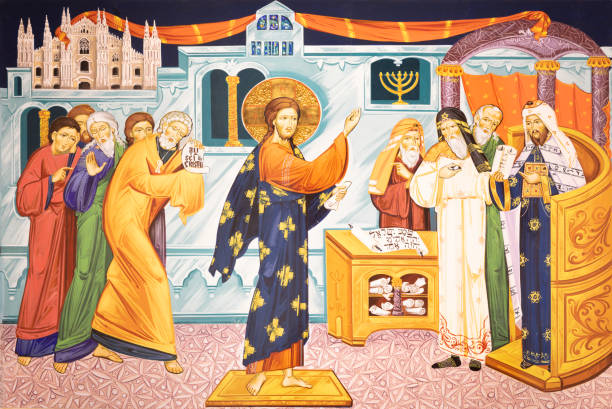
Hearing that Jesus had silenced the Sadducees, the Pharisees got together. One of them, an expert in the law, tested him with this question: "Teacher, which is the greatest commandment in the Law?" (vv. 34-36)
The Pharisees aren't questioning Jesus out of good motives; because they want to learn something. This isn't like when Nicodemus came to Jesus at night. Nicodemus came to learn from Jesus because He believed in Him, or at least he was beginning to. By his question the lawyer wants to catch Jesus in His words so that they can destroy Him. They think that they already know all that they need to know about God's Law, what it is, and their keeping of it.
II. Jesus Preaches the Law
Jesus replied: "'Love the Lord your God with all your heart and with all your soul and with all your mind.' This is the first and greatest commandment. And the second is like it: 'Love your neighbor as yourself.' All the Law and the Prophets hang on these two commandments. (vv. 37-40)
Jesus gives the lawyer who asked Him the question an answer without hesitation. And it's the right answer. In Mark's Gospel, he records that the lawyer praised Jesus for what He said. So Jesus and the Pharisees agree about the Law: it requires us to love God with our entire being, and to love our neighbor as ourselves.
What does it mean, though, to love God with all your heart, soul, and mind; with your entire being? Luther explains it this way in the Small Catechism: What is the First Commandment? You shall have no other gods. What does this mean? You should fear, love, and trust in God above all things. God is the one from whom we are to expect all good; the one in whom all our hope and confidence is to be placed. And when we don't do this; when we fear other things, when we love other things, when we trust other things; when we look to anything other than God for our good, we make that thing into our god. We become idolaters.
This is what the Pharisees are doing. They think that they are loving God with their entire being, but what they are really fearing, loving, and trusting above all things is the praise that they get from other men for being so pious and holy; they think that they are right with God because of the fact that they are children of Abraham, that is, physical descendants, blood relatives of the patriarch. That's what they trust in. Those are their idols.
When I hear Jesus' summary of the Law here, that I am to love the Lord with all my being, and to love my neighbor as myself, I start to better understand what our Lutheran Confessions mean when they say that the Law always accuses. I feel that accusation because I know what my heart really fears. It fears things like being poor; like not having enough money to provide for the needs of my family. It fears getting sick. It fears getting old and losing my mental capacity. It fears dying.
My heart also loves things. It loves things like all those worldly pleasures I spend time chasing after to entertain myself, to make myself feel good, and to have a comfortable life. My heart trusts in my intellect, in my reason, in my own work ethic to provide for myself; my heart loves to trust in the things I do, so everyone can see how good I am, even though it doesn't fool me, them, or God. Perhaps your heart is in a similar situation.
By His answer to the lawyer, Jesus holds up the mirror of the Law to us, so we can see just how ugly our hearts look in that light.
III. Jesus Preaches the Gospel
So now it's Jesus's turn to ask a question.
While the Pharisees were gathered together, Jesus asked them, "What do you think about the Christ? Whose son is he?" "The son of David," they replied. He said to them, "How is it then that David, speaking by the Spirit, calls him 'Lord'? For he says, 'The Lord said to my Lord: Sit at my right hand until I put your enemies under your feet. If then David calls him 'Lord,' how can he be his son?" No one could say a word in reply, and from that day on no one dared to ask him any more questions. (vv. 41-46)
Jesus asks the Pharisees a question about the Christ, and they answer rightly. They say he's the Son of David. But they don't really know what that means. Jesus shows, using Psalm 110, how the Christ is more than just a physical descendant of David. He is the Anointed One of God who sits at God's right hand with His enemies under His feet. He is the one who is called a priest forever, in the order of Melchizedek; the one who will judge the nations, heaping up the dead, and crushing the rulers of the whole earth (Ps. 110: 1, 4, 6). More than that, the Christ would also be the Suffering Servant, by whose stripes all of mankind would be healed. Jesus declared that He was this Christ all throughout His earthly ministry, but the Pharisees refused to see the fulfillment of the Scriptures that was right in front of them.
Jesus asked the same question to Peter in Matthew 16. "Who do you say I am?" Simon Peter answered, "You are the Christ, the Son of the living God." (Mat. 16:15-16). Peter answered rightly out of a spiritual understanding, with an answer that Jesus said came from His Father in Heaven. But when Jesus explained what His work as the Christ would be, that is, that He would suffer many things in Jerusalem, that He must be killed, and on the third day be raised to life, Peter rebuked Him, going back to trusting in his own human reason. He couldn't see what was right in front of him either, at least until after the resurrection.
The ones who could see, were the sinners; the people whom the Pharisees looked down on as beneath them. They were people like blind Bartimaeus, who cried out for mercy from the Son of David as Jesus passed by on the road; all those tax collectors and sinners, who also saw their sin reflected back at them in the Law, just like we do, and believed that in Jesus they had forgiveness and reconciliation with the Father; all those disciples of John who were baptized into a baptism of repentance, and who followed Jesus when John showed them the Lamb of God who takes away the sin of the world; all those people who shouted "Hosanna to the Son of David!" as Jesus entered Jerusalem to die for the sin of the world, they all could see who the Christ was.
And it is in this atoning, sacrificial death of Jesus that we have refuge from the accusations of the Law. When we look into this mirror and see our sin reflected back at us, we feel sorrow; we confess it. But we also believe His promise that all that sin has been taken from us; atoned for by the death of Jesus, the Christ. At the cross, our enemies of sin, death, and the devil have been put under Christ's feet. He has taken away the guilt of all our misplaced fear, love, and trust. He has given us His Spirit in holy baptism, by whose power we now are able to fear, love, and trust in God above all things. And, out of this love for God, we truly begin to love and serve our neighbor.
In the name of Jesus; Amen.
Last updated 7 October 2026
josephdklotz.com